
Have you just visited an eye care professional and given a piece of paper or report with your prescription on it but do not understand what it means? The abbreviations and numbers can seem complicated and difficult to comprehend but in fact they can be easily understood. This article aims to help you to understand your prescription and eye health better!
What is an eye prescription?
An eye prescription is used for vision correction for people who may have refractive errors such as myopia, hyperopia, astigmatism, and presbyopia. It consists of a string of numerical numbers which indicates the “power” of the lenses required to achieve sharp vision. You can typically get your prescription from a refraction test done by your eye care professional.
Examining your own prescription: What do the numbers mean?
If you’ve ever taken a close look at your prescription, you may have noticed a lot of letters and numbers which does not make any sense. We will attempt to break down the letters and numbers to make it easier to understand.
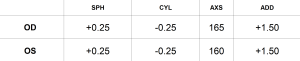
What does OD and OS mean?
If your prescription does not have “Right” and “Left” labelled for you, you may not know which eye the prescription belongs to. However, you may notice the prescription labelled “OD” and “OS” on your report. These are Latin abbreviations to indicate right and left side of your eye. “OD” means “Oculus Dexter” which represents the Right eye and “OS” means “Oculus Sinister” which represents the Left eye.
Diopters (D)
Before we get into reading the numerical portion of your prescription, we first look at what diopters mean. Diopters which are denoted by “D” in your prescription or sometimes left out as it is universal to eye care professionals is how your refractive power is measured. In Singapore, you may hear people describing their prescription in degrees which is a layperson description, for example is 500 degrees of near-sightedness is written as -5.00 D.
What is “SPH”?
Now that you know which eye you are looking at and how refractive power is recorded, you will see “SPH” being the first number of your prescription. SPH stands for Spherical which indicates if you have near-sightedness (myopia) or far-sightedness (hyperopia). To tell the difference between both, we need to look if the number is negative or positive which is denoted by “-” or “+” symbol. A minus sign in the SPH column would mean that you are nearsighted, and a plus sign would mean farsighted.
The number indicates the degree of nearsightedness or farsightedness, a higher number will mean a stronger prescription is required.
What is “CYL”?
CYL, or cylinder, is the second number listed on an eyeglass prescription. It indicates the amount of correction for astigmatism, which is an imperfection in the curvature of the eye’s cornea that prevents light from being focused correctly on the retina. The higher the number, the greater the degree of astigmatism. Cylinder power is always written as a plus or minus sign followed by a number; for example +2.00 or -1.50.
What is “AXS”?
AXS which represents Axis is the position of astigmatism, it is expressed as a number between 0 and 180. The axis value does not represent the severity of astigmatism but just the orientation.
What is “ADD”?
ADD is the Addition of your prescription, the value represents the reading lens power needed on top of your prescription. This value is usually present for anyone above the age of forty due to presbyopia and typically denoted with a “+” sign. It is used for any reading lenses including progressive lenses to help in near vision.
What prescription to get for glasses or contact lenses?
It is advisable to look for an eye care professional: eye doctor (Ophthalmologist), Optometrist or Optician after an eye exam to seek their opinion on which glasses prescription or contact lens prescription that suits you. At times, prescription given on your report may not be the most comfortable for you and some adjustments are required.
For contact lens wearers, the prescription tested differs for your contact lenses prescription due to the distance between your eye and the testing frame. Contact lenses rest directly on the eye and eliminates the distance, as such the amount of lens power will require adjustments to match your prescription glasses.
Conclusion: Eye Prescription Explained
We have summarised the above into a table:
| Abbreviation | Meaning |
| OD | Right Eye |
| OS | Left Eye |
| D | Diopters |
| SPH | Nearsightedness or Farsightedness |
| CYL | Astigmatism |
| AXS | Position of Astigmatism |
| ADD | Presbyopia |
With this table, we hope you can better read your eye prescription and understand how lens power is measured.